
The Trials of Aerlynn
2D - PIXEL ART - PLATFORMER - METROIDVANIAOverview
The Trials of Aerlynn is a 2D Metroidvania platformer built in Unreal Engine 5.4, created as an exploration of genre fundamentals and the design of responsive, satisfying movement mechanics.
Although the project began with a provided 2D Action Platformer template, I found the underlying systems to be a little inconsistent and inaccurate at times. For example, the sliding mechanic moved the player through forward using their position vector rather than interacting with gravity, physics, or collision in any sort of meaningful way. To achieve a more grounded and intuitive game feel, I rebuilt the character controller from scratch using UE5 Blueprints, ensuring that physics, momentum, and level geometry played an active role in moving around the world.
As a solo developer, I handled all aspects of implementation and integration. I adapted and edited sprite assets from external creator packs and created new animations to match the existing visual style (such as spellcasting animations for Dreamir’s Woman Warrior pack, and my own Blazing Pyre object sprites and animations). I also modified audio tracks in Audacity to produce seamless looping gameplay tracks. The project served as both a technical and design-focused exercise in understanding how systemic mechanics, visual cohesion, and player experience / feedback come together for a Metroidvania experience.
You can find credits for all the assets used in this project at the bottom of this page. Thank you to Dominik Rangel for creating original splash art for Aerlynn herself.
Gameplay Walkthrough
Gameplay Showcase
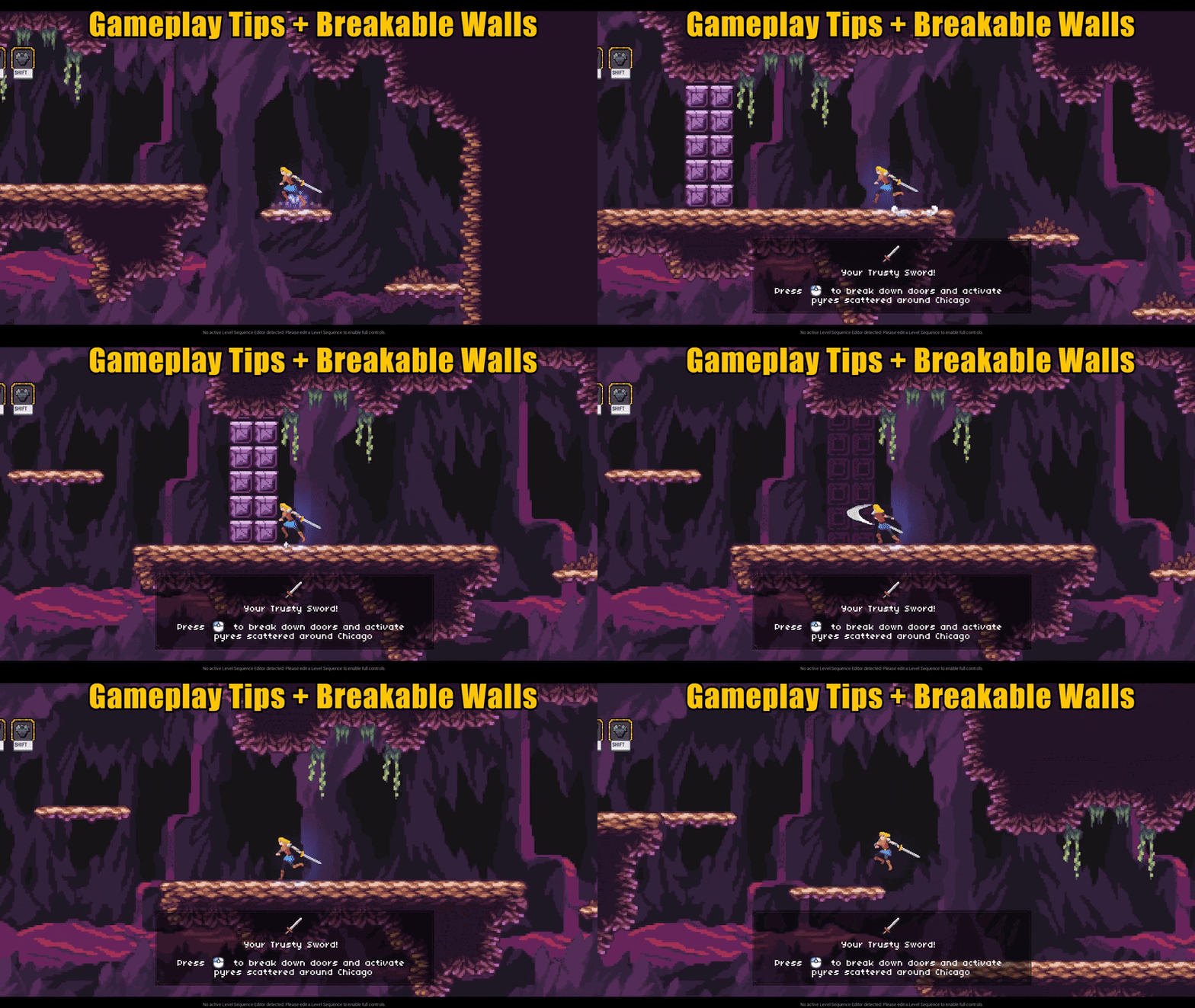
Throughout the game, tips will show up to help introduce power ups, mechanics, and locations. Some walls can be broken to open up new paths.
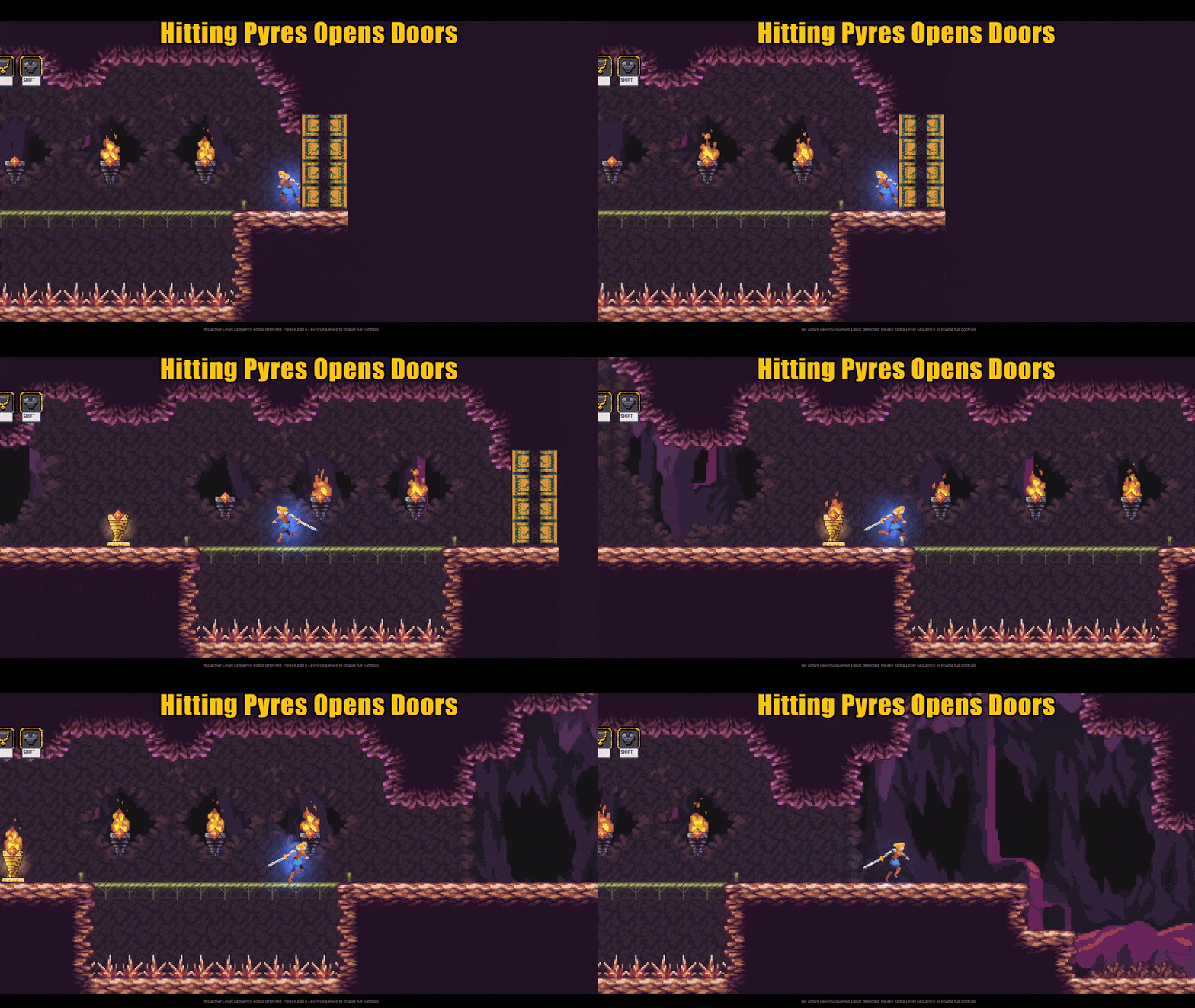
These stone and gold braziers with gemstones are called Pyres, but they're not all lit up yet. Hitting a certain amount of them will open up new doors across the map.
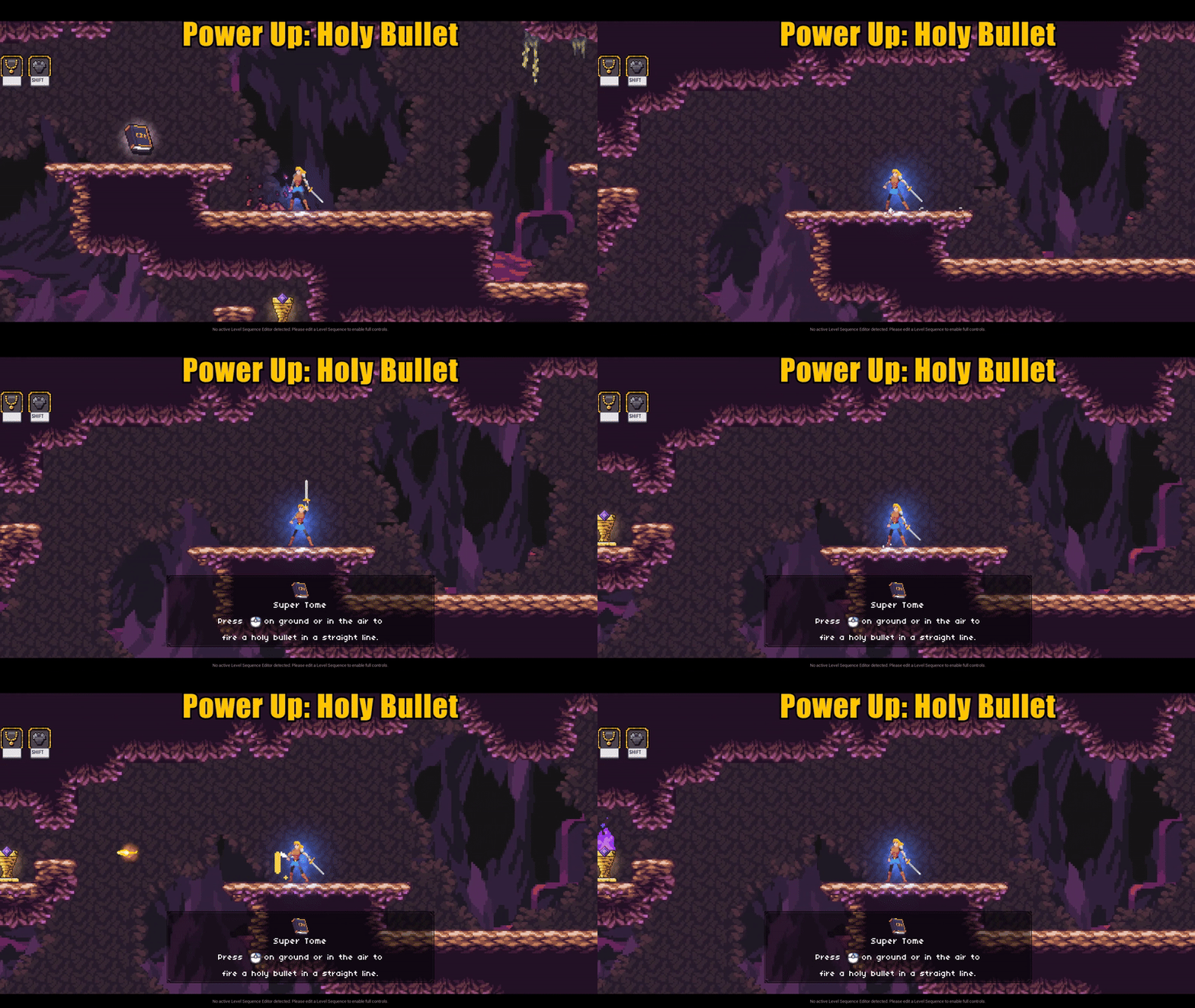
Item #1: The Super Tome. Casting it will fire a holy bullet forward that can trigger Pyres and damage enemies from afar!
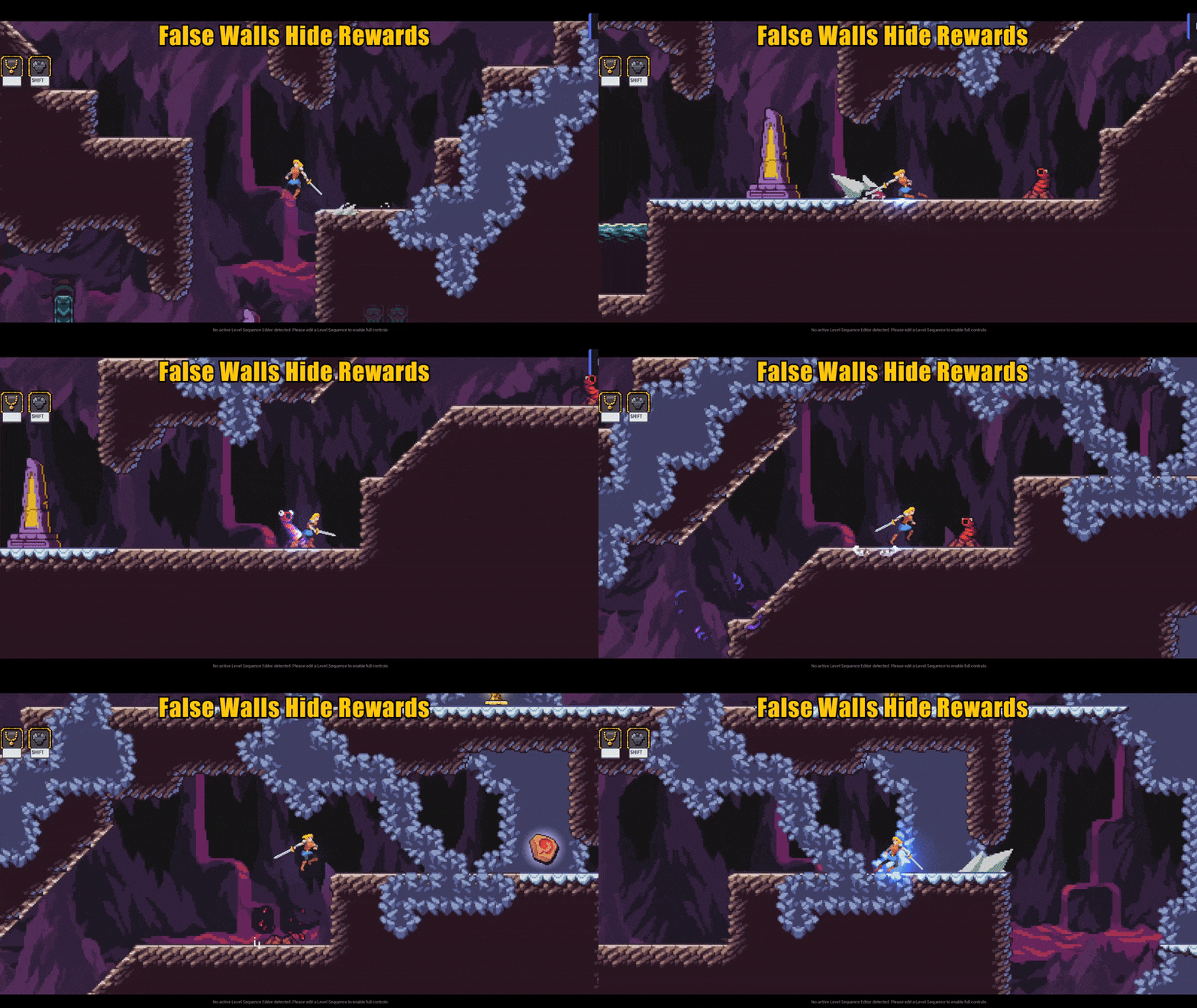
Some walls hide secrets and collectibles behind them!
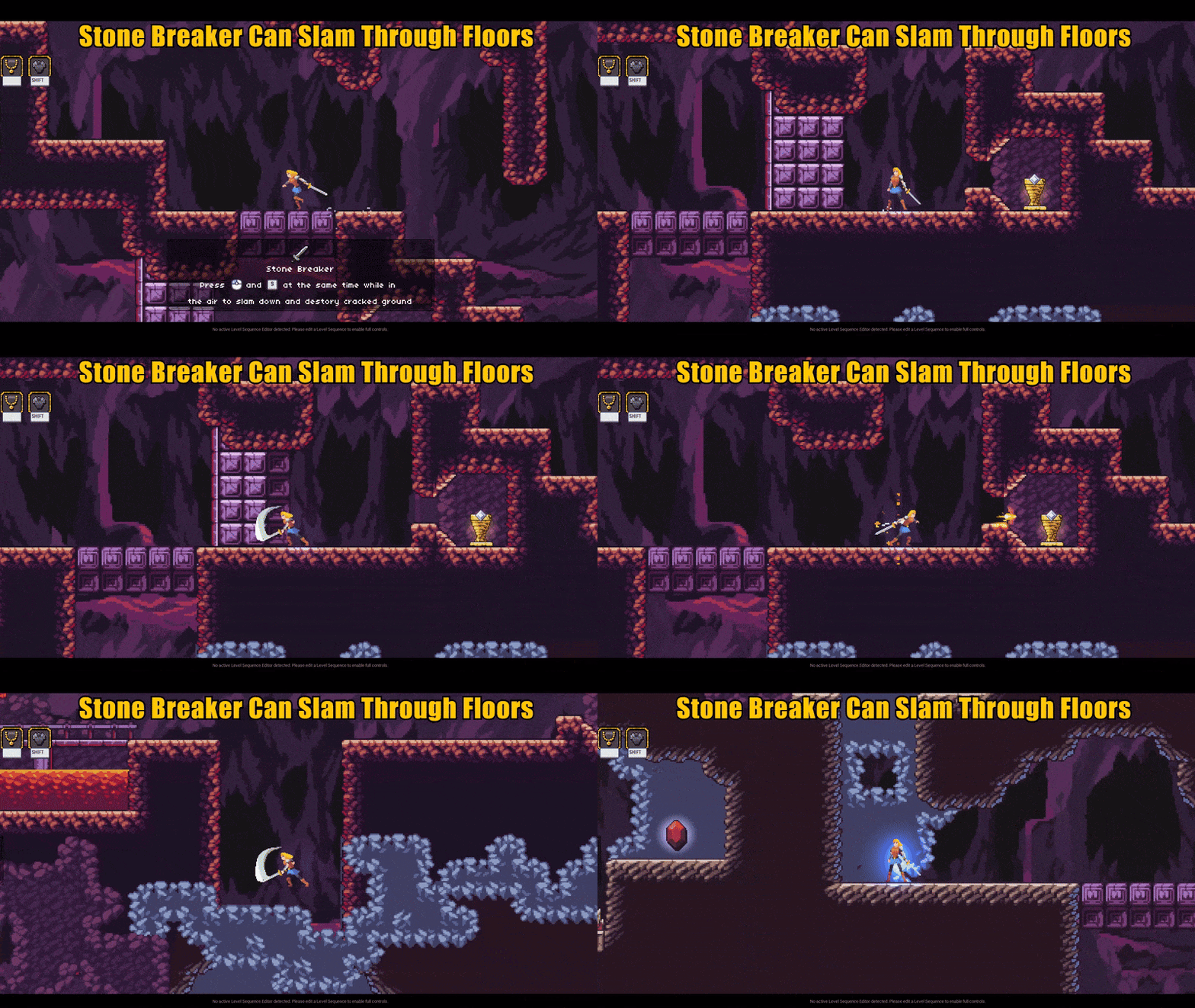
Item #2: Stone Breaker. Allows you to do a downwards slam attack while in the air and break through crumbling stone blocks.
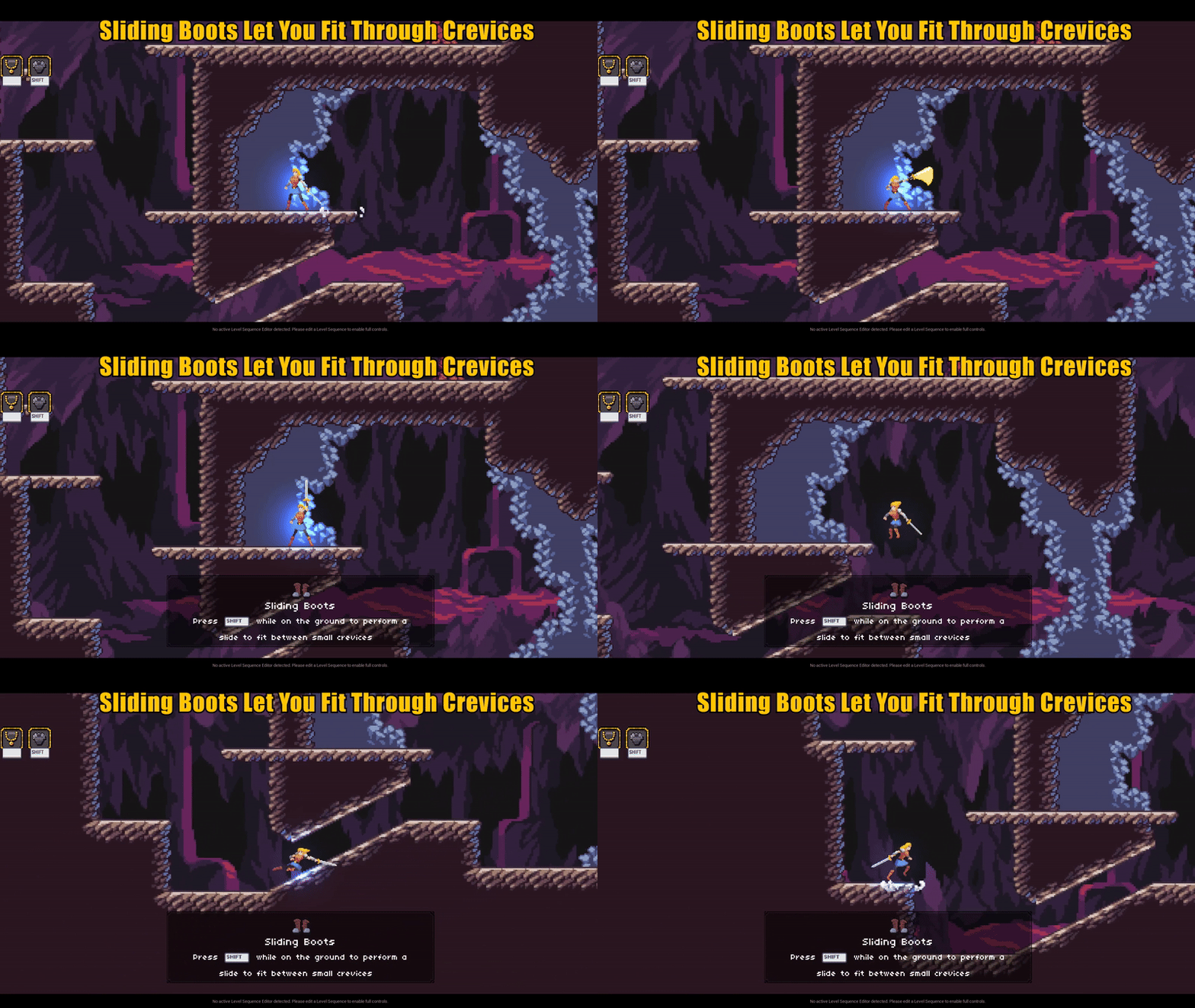
Item #3: Sliding Boots. Allows you to slide through small crevices, giving you a boost of ground movement.
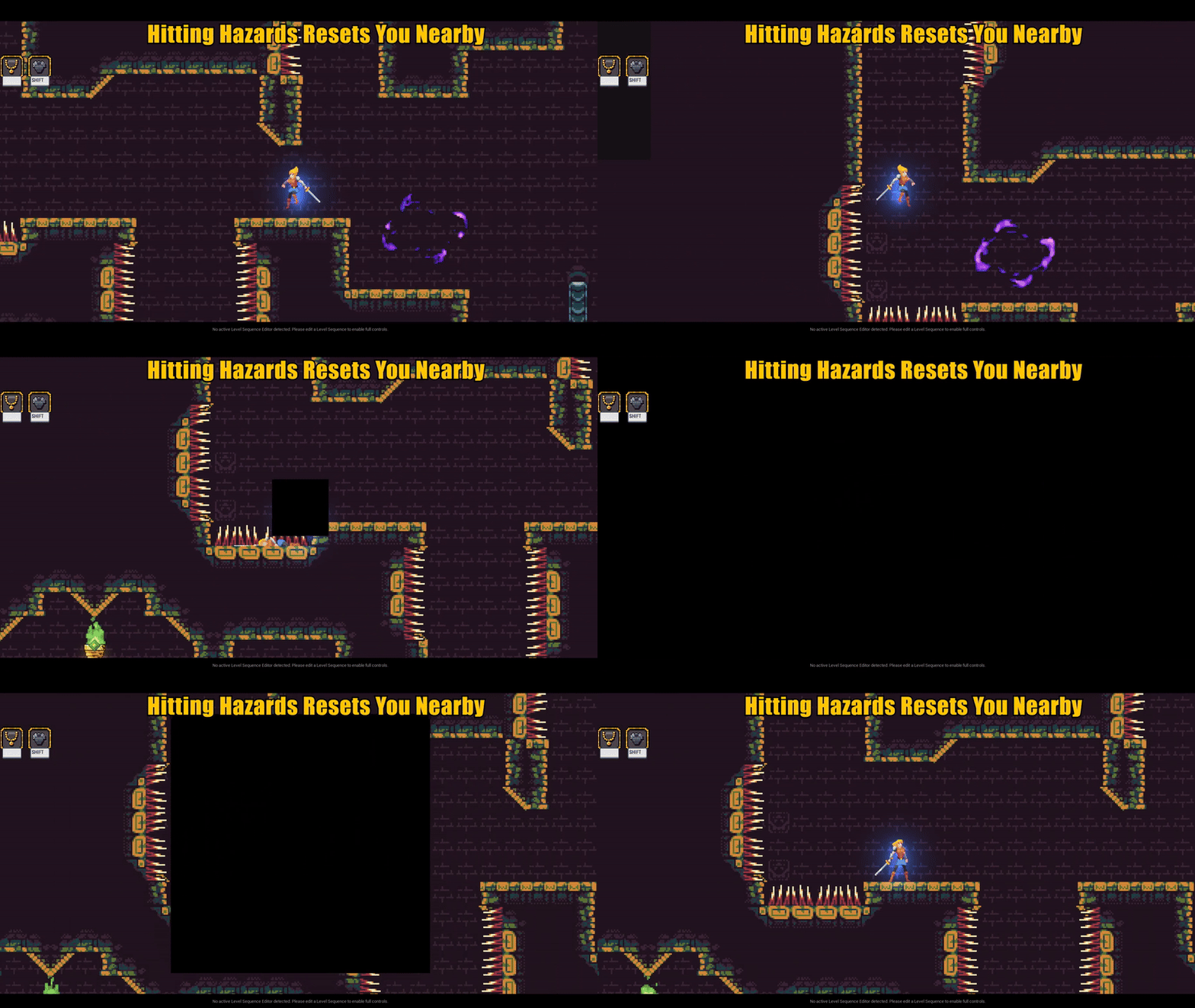
Hazards throughout the map won't kill you right away, they'll just send you to the nearest platform to try again!
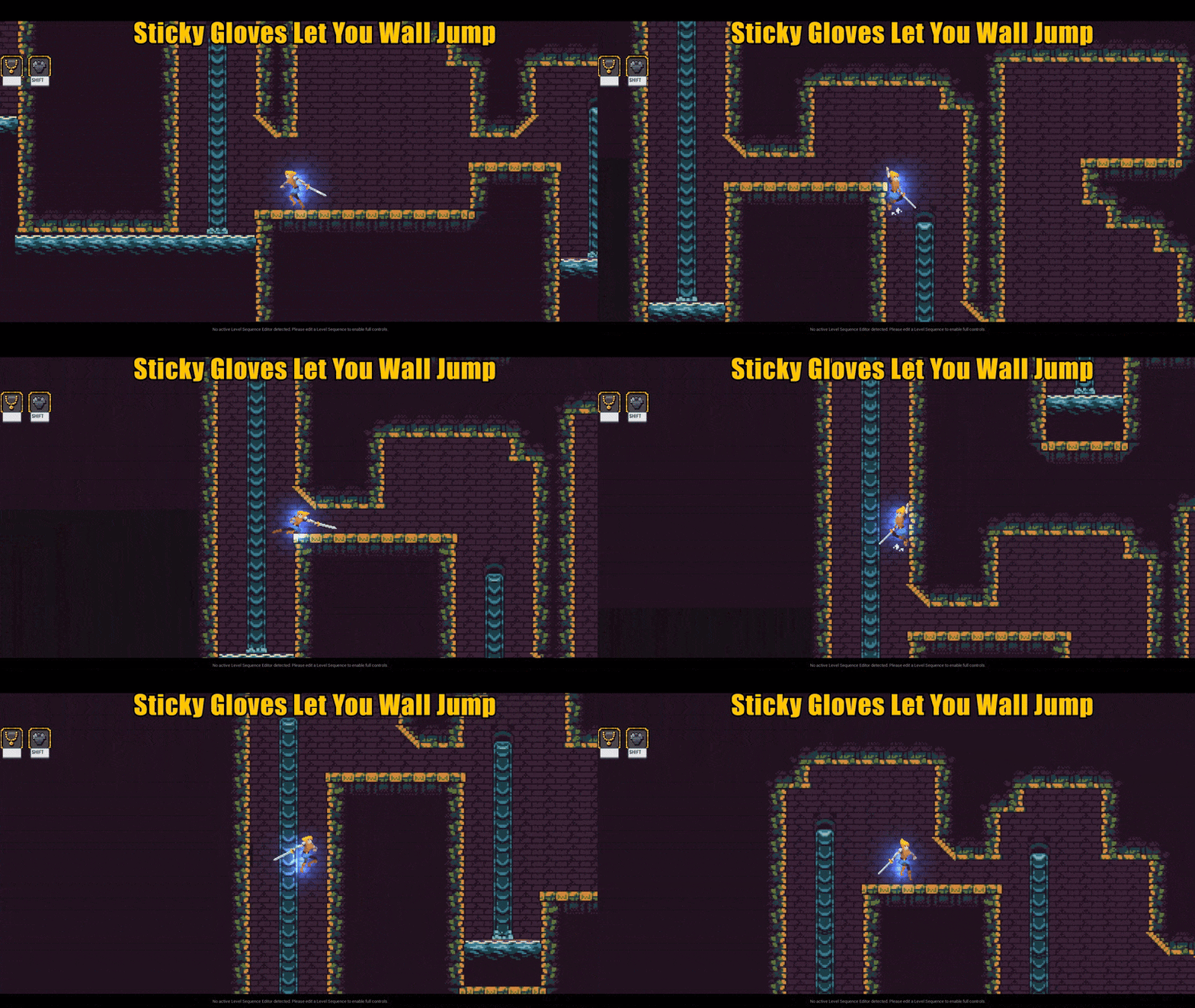
Item #4: Sticky Gloves. Allows you to cling to walls and jump from them, as well as slide down them slowly.
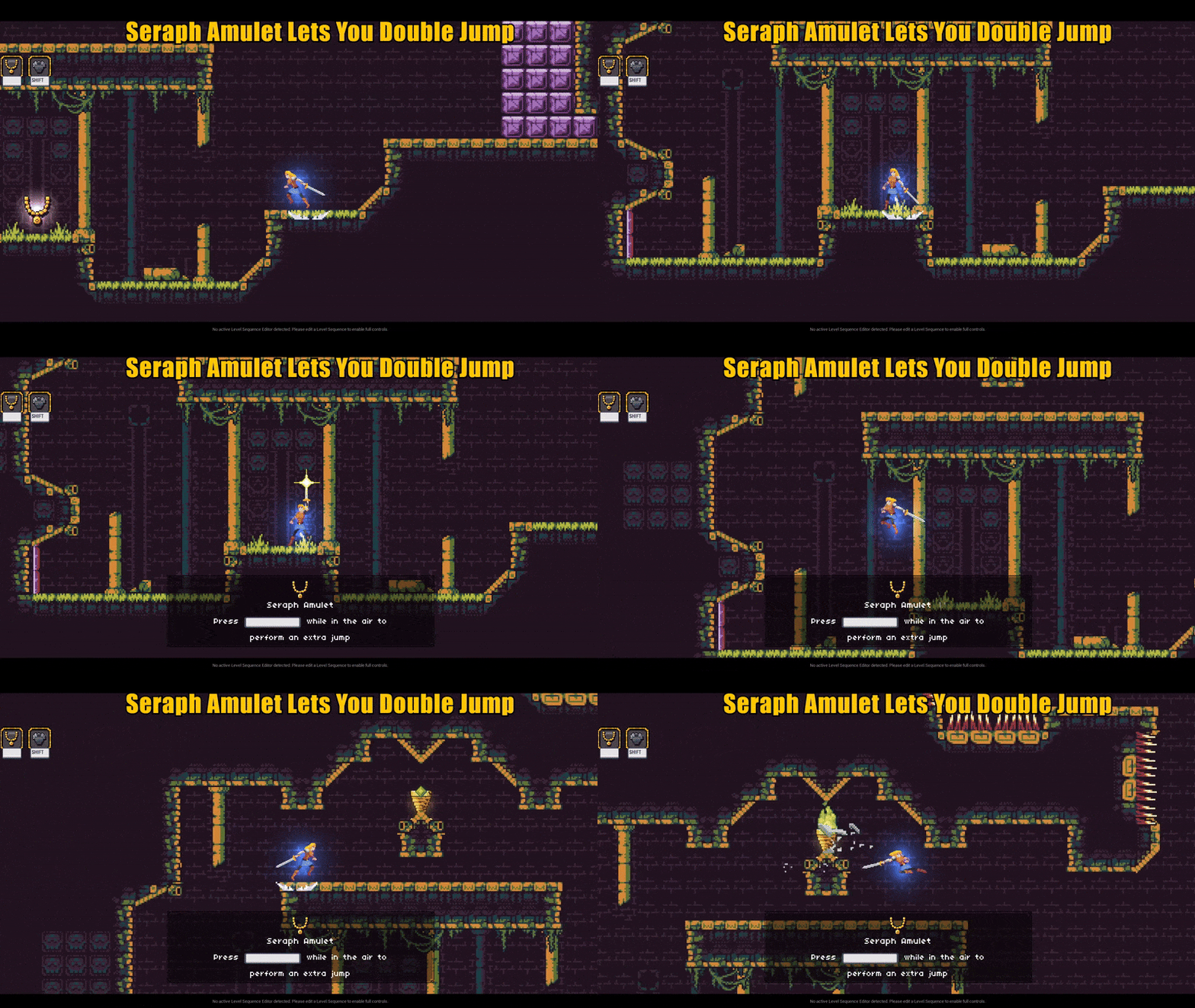
Item #5: Seraph Amulet. Allows you to jump again in the air to reach new heights!
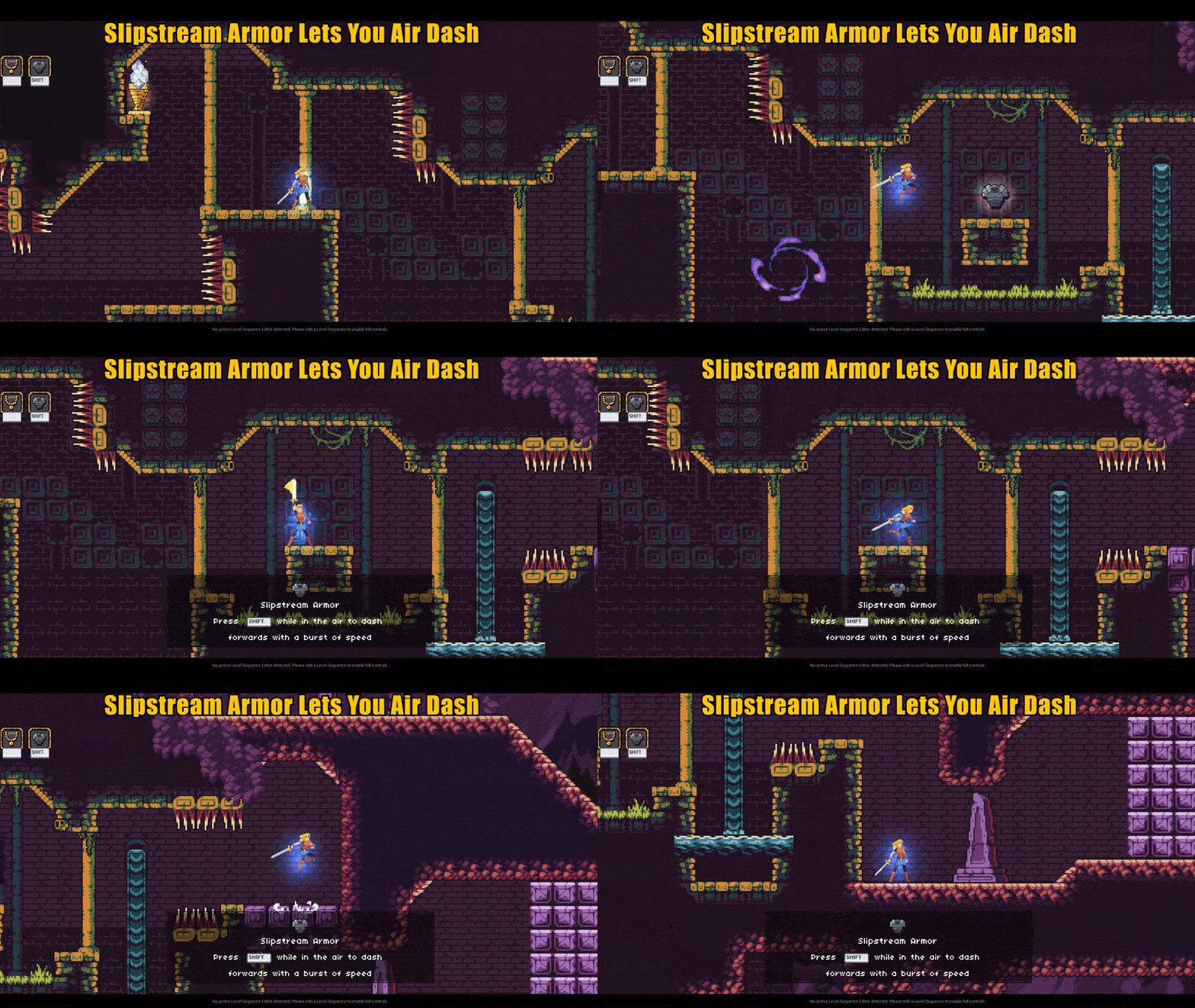
Item #6: Slipstream Armor. While in the air, you can press the Slide key to perform an air dash with a huge burst of speed! Be careful though, once used you can't do it again until you land.
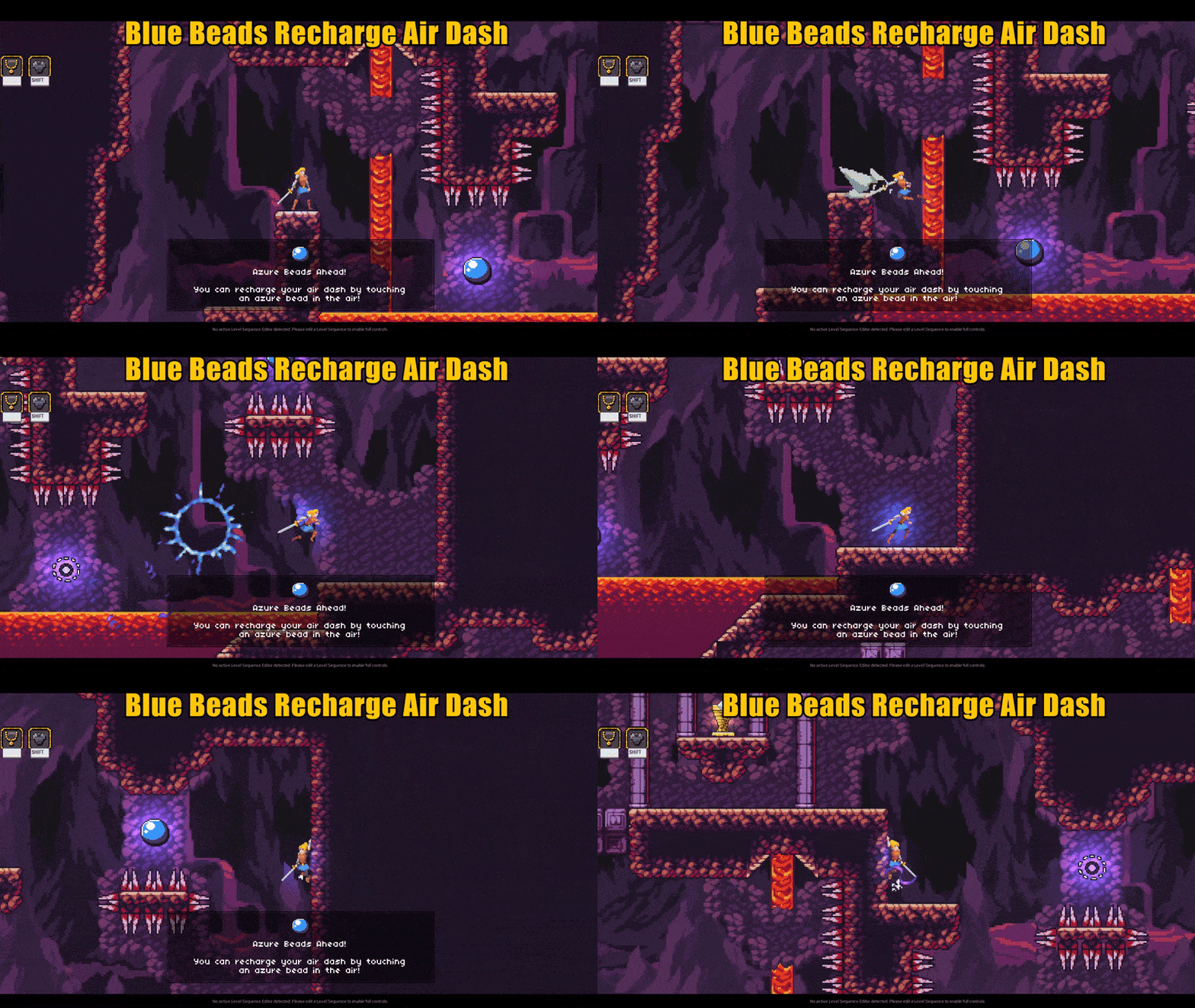
Look out for mystical Azure Beads. Grabbing them in the air will recharge your air dash immediately, allowing you to go even farther!
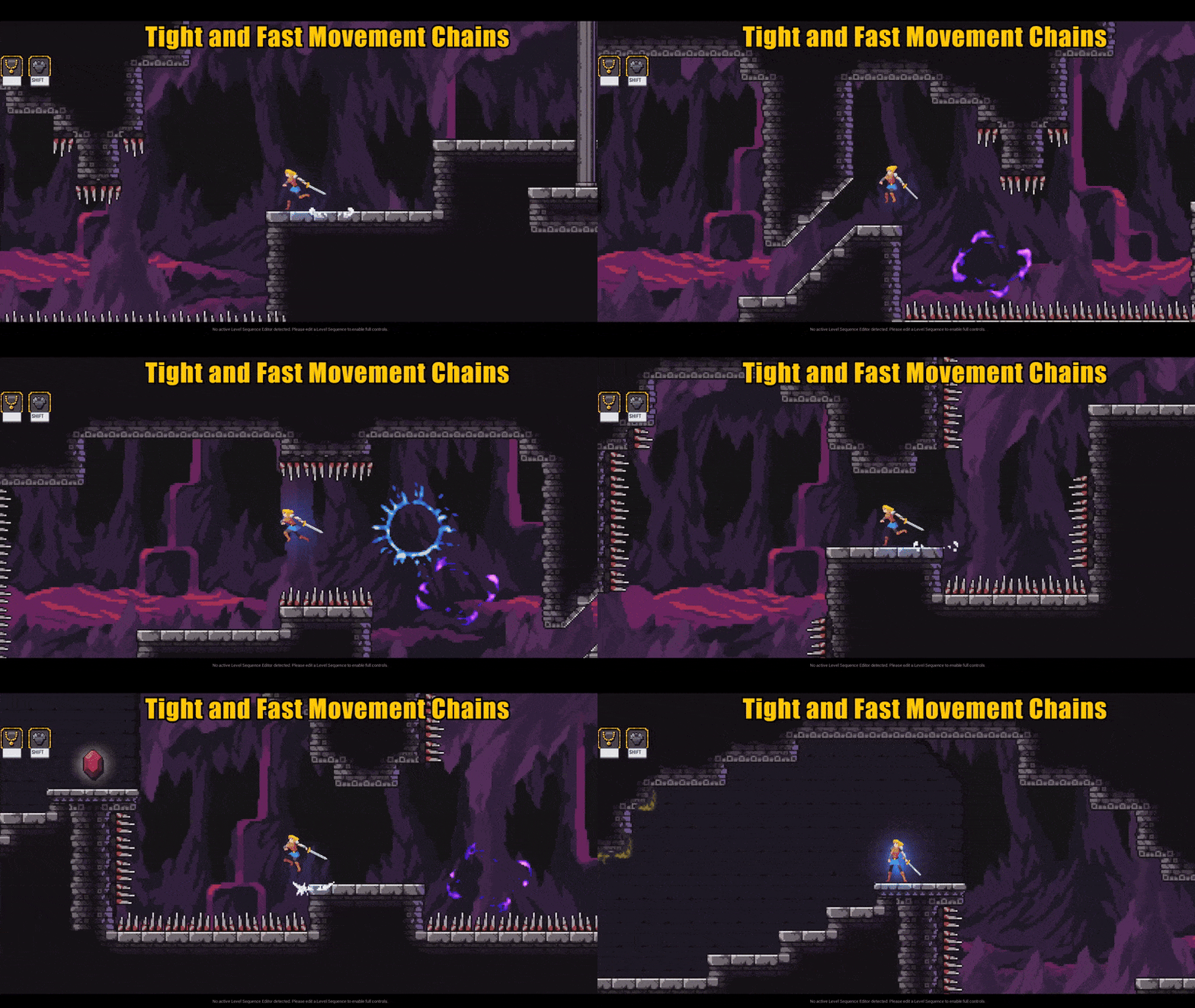
Using all your items and abilities together will be key to overcoming Aerlynn's trials and becoming a movement master!
Development Process
World First, Systems Second
This project began with a design-first, ask-questions-later mindset. Before touching mechanics, I wanted to design the map as a way to discover what abilities and systems the game should be built around. For me, a good Metroidvania isn’t just about the movement, it’s about giving players a good reason to explore, to return to familiar places with new tools, and to understand the world as a series of distinct regions with their own identities and challenges.
Hollow Knight was a major reference point. The level layouts and maps do a great job of communicating terrain, difficulty, and progression, helping players visualize where they’ve been, where they are, and where they might want to explore next. I wanted to capture that same sense of space and logic, even if it was at a smaller scale.
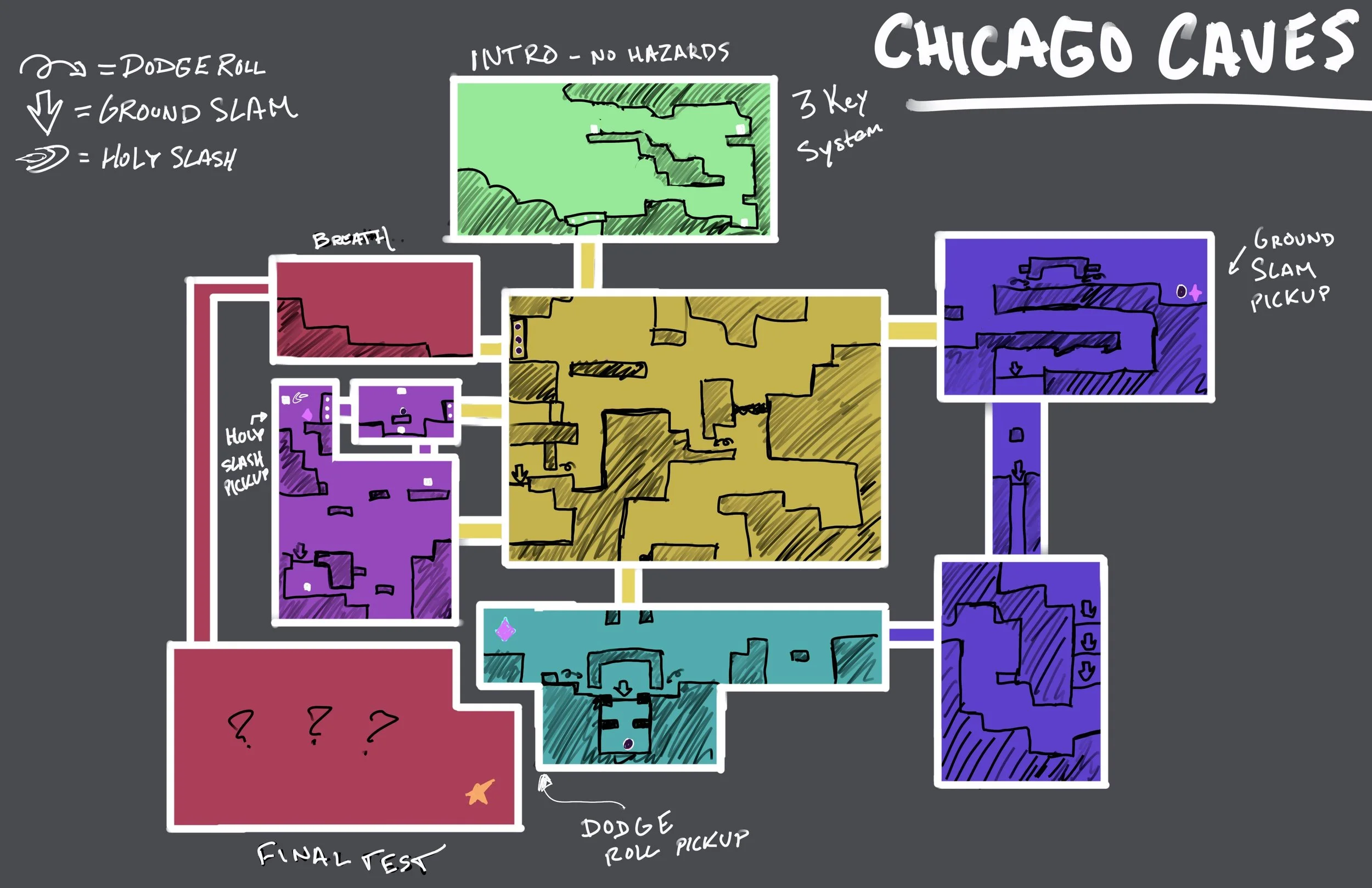
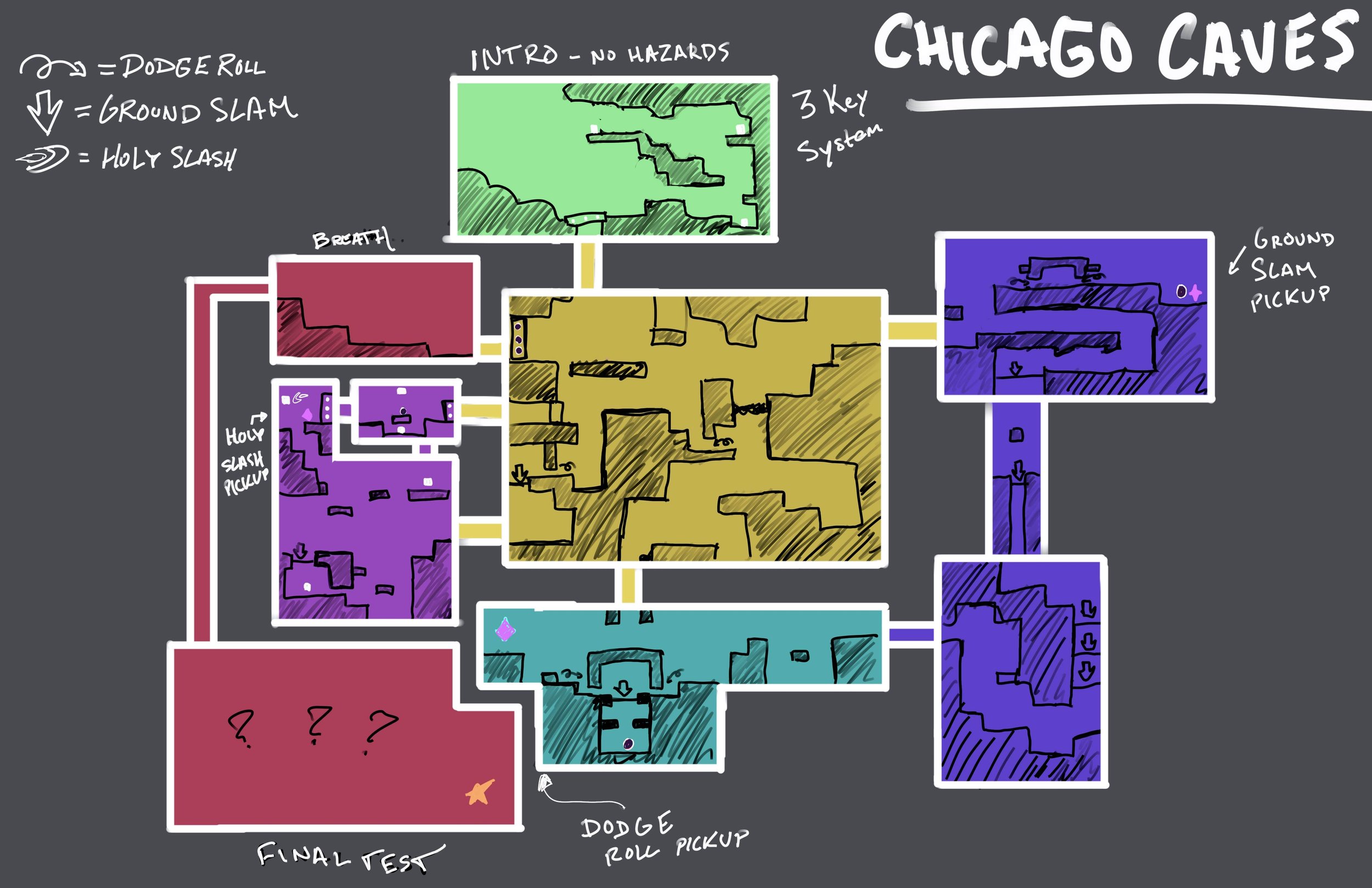
I knew I wouldn’t be able to implement a fully dynamic fog-of-war map within my roughly one-month timeline, but emulating that structure on paper (or iPad) still shaped how I designed my zones. This hand-drawn map represents my earliest vision for Aerlynn’s world, though the original concept was much smaller and far less serious in tone. Early on, the project was called Caves of Chicago, built around the absurd idea of Chicago as a medieval fantasy land treated with the same ominous reverence as Mordor is in the Tolkien books. The idea never left me though, and you’ll find some cheeky references still leftover in the game.
Going Up (or Down)
Once the map structure and character controller were in place, the next step was integrating sprites and tiles so that I could test the game as a complete system with movement, collisions, visuals, and objectives all working together. Having worked with sprites and tilesets on Devil’s Gambit, I was comfortable with the fundamentals, but Unreal Engine 5 handled tile workflows very differently from what I was used to.
Asdasfasf
I’ll spare the deep technical breakdown, but one major difference was UE5’s lack of tile rules. Unlike Unity that allows a sort of “smart” tile to automatically adapt to their surroundings (corners, edges, inner corners, transitions, etc), every tile in Trials of Aerlynn had to be placed by hand. There was no automation, no procedural shaping, just deliberate brick-by-brick construction. It was painstaking, but it also forced me to be more critical about how every surface, corner, and silhouette affected movement and readability.
As the map evolved, so did the scope. What started as small, contained ideas quickly grew into mechanics that leaned heavily on 2D physics, impulses, and environment interactions. I repeatedly refactored by Blueprint systems to support new behaviors, which turned the project into an ongoing dialogue between level design and mechanics rather than a linear build process.
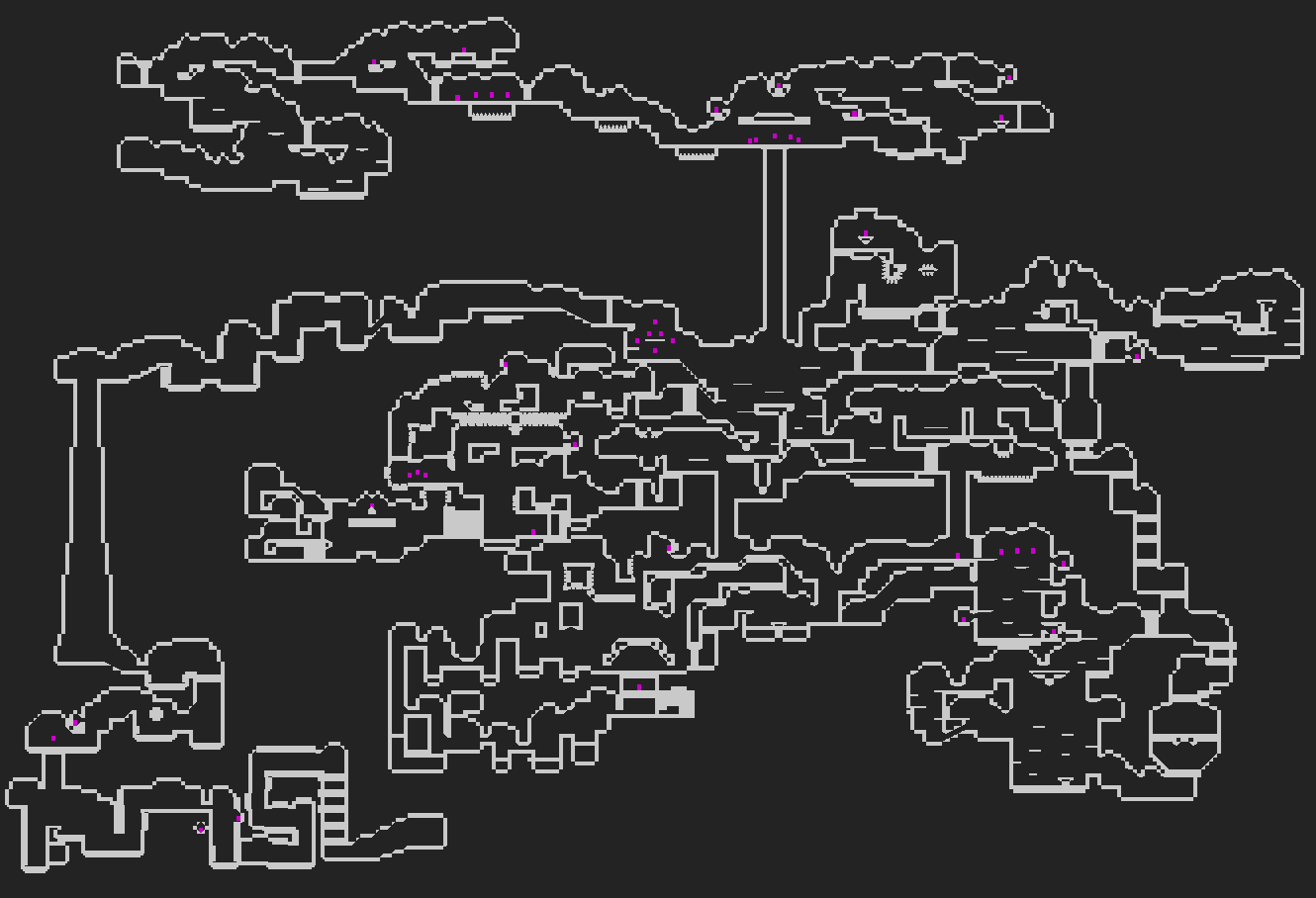
Final collision map of The Trials of Aerlynn, representing every room and key gameplay objects. The level is shown in its raw collision layout, highlighting the structure of the world without visual art or decoration.
If you’re curious about the project’s original version, you can download the early design one-sheet here, silliness and all. At that stage, the game was built around just three core abilities:
Sword Piercer — Ground Slam
Break cracked platforms by slamming downward while airborne.
Hero’s Cape — Dodge Slide
Roll with SHIFT to shrink your hitbox, slip through tight spaces, and briefly become invulnerable.
Holy Amulet — Holy Slash
Empower your aerial attacks to create a larger hitbox, allowing you to reach distant or elevated targets.
The initial plan included only six regions, each designed around two primary objectives, with progression gated by abilities earned elsewhere. The final area was conceived as a cumulative challenge that required mastery of all mechanics. The core idea survived my iterations, but the scale of the world expanded dramatically, evolving into the sprawling map showed here.
The final layout begins with a large “above ground” tutorial space that teaches the fundamental systems:
Movement and spacing
Jumps and vertical navigation
Hazards and environmental threats
Doors and key-based progression
Respawn logic and checkpoints
Items and abilities
Collectibles and hidden / optional paths
Once players internalize these systems, a central platform unlocks, and the true structure of the game opens up. If you want to find out what it’s all about, you’ll just have to try it out yourself at my Itch store above (for completely free!)
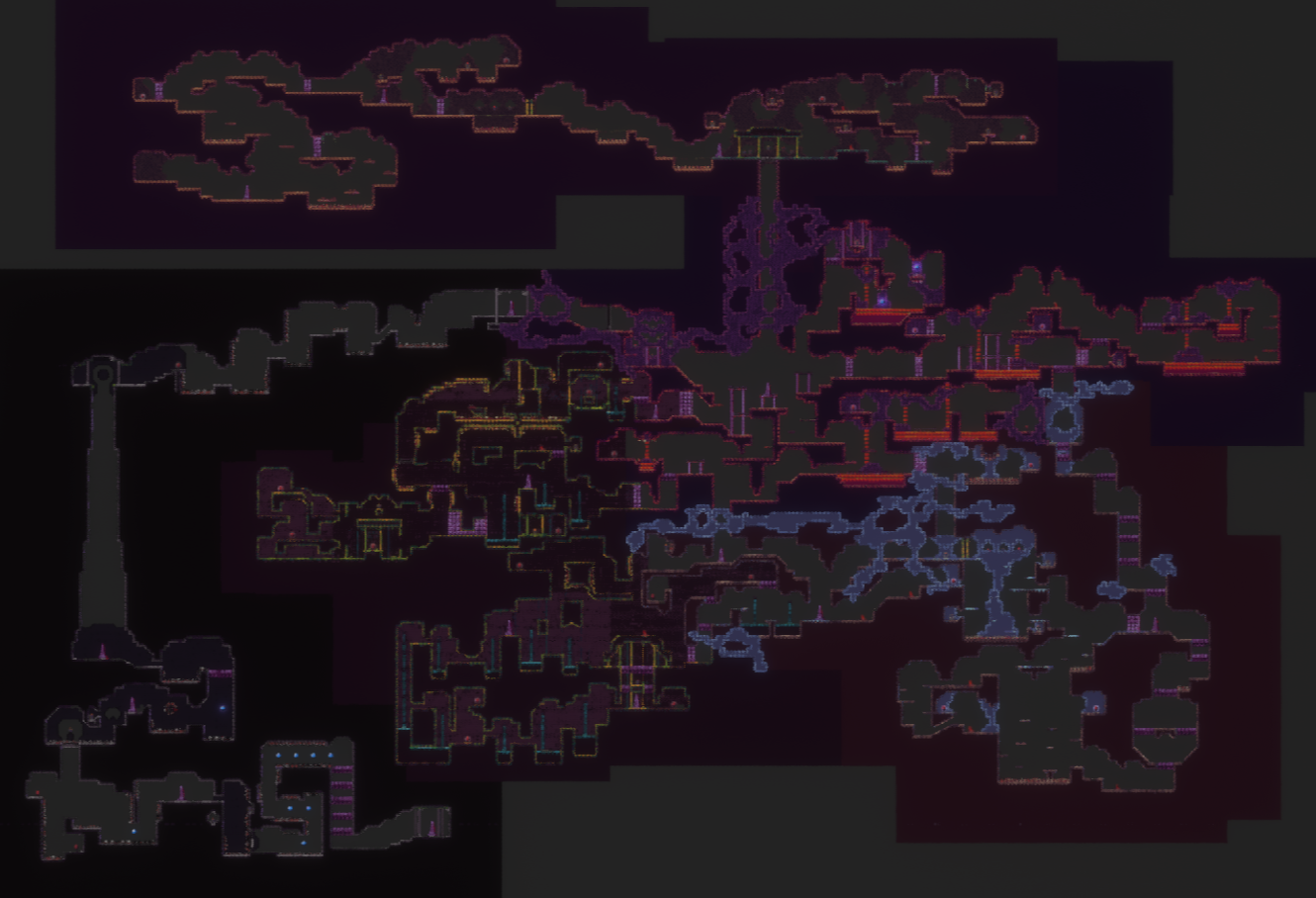
The Trials of Aerlynn map with the full environment visible, showing how the abstract layout evolves into a readable, explorable world. This view highlights the scale and complexity of the final level design.
Asset Credits
LICENSED UNDER CREATIVE COMMONS
Character Sprites
Woman Warrior
Dreamir
Tilesets, Backgrounds, and Enemy Sprites
Fantasy Winter, Ancient Temple, Fantasy Caves, Lava Caves
by aamatniekss
Music
Dark Dissimulation
by Joel Francis Buford
8-bit Action Music & SFX
by Joel Steudler
Vaniacore
by DanielTelesOST
SFX
Dark Dissimulation
by Joel Francis Buford
8-bit Action Vol 1
by Joel Steudler
8-Bit Explosions Free Sound Effects
by _zebzorb
VFX
Smoke N Dust 2, Holy VFX
by pimen
UI
Shikashi’s Fantasy Icons
by Shikashi
Fantasy Borders
from Kenney’s Game Assets
Retro Inventory
by ElvGames
Fonts
Kingdom
by Gleeson
BitPotion
by Joeb Rogers
SFX
Dark Dissimulation
by Joel Francis Buford
8-bit Action Vol 1
by Joel Steudler
8-Bit Explosions Free Sound Effects
by _zebzorb